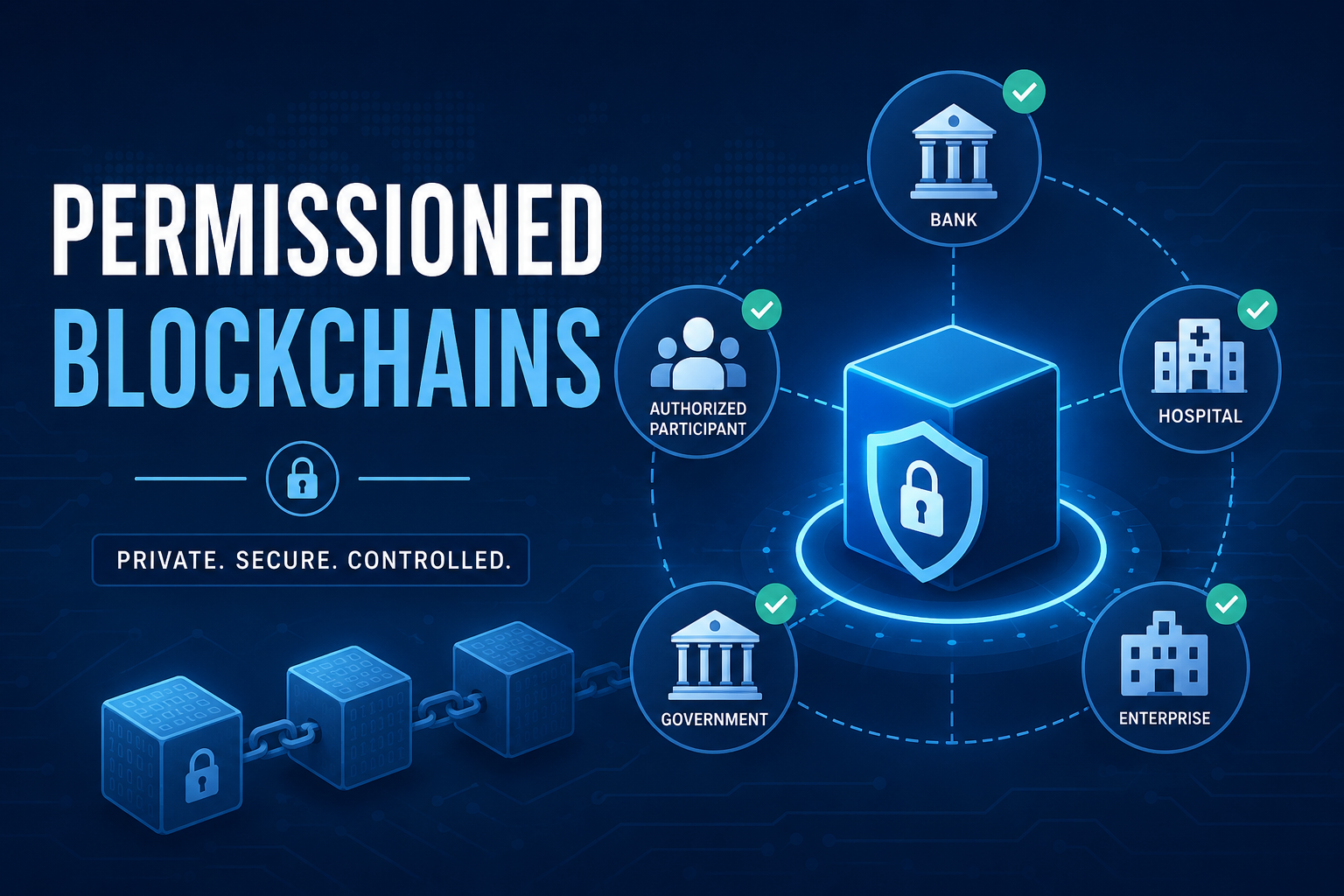
Permissioned blockchains have emerged as a leading solution for enterprises seeking secure, scalable, and efficient digital systems. Unlike public blockchains, where anyone can participate, permissioned systems restrict access to authorized participants only. This controlled environment makes them especially attractive to businesses that require privacy, compliance, and governance.
Enterprises across industries—from finance to healthcare—are rapidly adopting permissioned blockchains. Why? Because they strike the perfect balance between transparency and control.
Permissioned Blockchains are distributed ledger systems where access is restricted to a predefined group of participants. Every user must have approval to join the network, and their actions are governed by rules set by the network administrator.
Unlike open systems, these blockchains prioritize security and governance, making them ideal for enterprise use.
Businesses handle sensitive data daily. Permissioned Blockchains ensure that only trusted participants can access and validate transactions, reducing the risk of breaches.
Enterprises must comply with strict regulations. Permissioned systems allow organizations to enforce compliance rules directly into the network.
Public blockchains often suffer from congestion. Permissioned Blockchains offer faster transaction processing due to limited participants.
Organizations can define rules, roles, and permissions, ensuring smooth operations and accountability.
With fewer nodes and less computational power required, enterprises can reduce operational costs.
Permissioned Blockchains use identity management systems to verify participants before granting access.
Instead of energy-intensive methods like Proof of Work, these systems use efficient algorithms such as:
Sensitive data can be encrypted or restricted to specific participants within the network.
Every transaction is recorded and traceable, making auditing straightforward.
Banks use permissioned systems for faster and secure cross-border payments.
Companies track goods in real time while maintaining data privacy.
Hospitals securely share patient data among authorized professionals.
Governments use blockchain for identity management and record-keeping.
Some of the most popular platforms include:
These platforms demonstrate how Permissioned Blockchains can be tailored for specific industries.
Despite their advantages, they also have limitations:
The future looks bright for permissioned blockchains. As businesses continue to digitize operations, the demand for secure and scalable solutions will grow. Emerging technologies like AI and IoT are also integrating with blockchain, further boosting adoption.
According to industry insights from organizations like IBM, enterprise blockchain adoption is expected to accelerate significantly in the coming years.
Permissioned blockchains are clearly leading the enterprise blockchain revolution. Their ability to combine security, efficiency, and control makes them a perfect fit for modern business needs. While public blockchains remain important for decentralized applications, enterprises are increasingly choosing permissioned systems for practical, real-world use cases.
As technology evolves, permissioned blockchains will continue to shape the future of digital transformation across industries.
A well-known example of a permissioned blockchain is Hyperledger Fabric. It is widely used by enterprises for supply chain tracking, finance systems, and secure data sharing. Other examples include R3 Corda and Quorum. These platforms restrict access to authorized participants while still maintaining distributed ledger benefits.
A permissioned blockchain allows multiple trusted organizations to participate under a controlled access system, often forming a consortium. A private blockchain, on the other hand, is controlled by a single organization that has full authority over who can join and what they can do. In simple terms, permissioned blockchains are shared across organizations, while private blockchains are typically owned and managed by one entity.
Permissions in blockchain refer to the rules that define what actions a user or node can perform within the network. These may include:
In permissioned blockchains, these permissions are strictly controlled to ensure security and compliance.
Open (or public) blockchains allow anyone to join, participate, and validate transactions without approval. Examples include cryptocurrencies like Bitcoin and Ethereum.
In contrast, permissioned blockchains require users to be verified and authorized before accessing the network. This makes them more suitable for enterprise environments where privacy, governance, and control are essential.
Yes, permissioned blockchains are considered highly secure because access is limited to verified participants. They also use advanced consensus mechanisms and identity verification systems, reducing the risk of malicious activity. However, security also depends on how well the governing organization manages the network.
Enterprises prefer permissioned blockchains because they offer:
These advantages make them ideal for industries like banking, healthcare, and supply chain management.
Yes, but only partially. While permissioned blockchains are not fully decentralized like public blockchains, they can still distribute control among multiple trusted organizations. This is often called a consortium blockchain model.
Industries that handle sensitive data benefit the most, including:
These sectors require both security and controlled access, making permissioned blockchains ideal.