As blockchain adoption accelerates, tokenized assets—from NFTs to real-world assets (RWAs)—are transforming how we own and trade value. But here's the uncomfortable truth: many of these assets rely on outdated, centralized storage systems.
That's where things start to break.
Even though blockchains are decentralized, the files tied to tokens—images, metadata, documents—are often stored on centralized servers. If those servers fail, get hacked, or go offline, your asset could lose its value instantly.
This is exactly why IPFS and decentralized storage have become critical in the Web3 ecosystem.
Centralized storage systems were never designed for decentralized ecosystems. Here's why they fall short:
1. Single Point of Failure If a server goes down, your data becomes inaccessible. For NFTs, that could mean missing artwork or broken metadata.
2. Data Tampering Risks Centralized systems allow data to be altered or replaced, compromising trust.
3. Broken Links Many NFTs store metadata using HTTP URLs. If the hosting server disappears, the NFT becomes useless.
4. Vendor Lock-In You depend entirely on one provider, limiting flexibility and increasing long-term costs.
5. Scalability Issues As demand grows, centralized systems struggle to scale efficiently.
The InterPlanetary File System (IPFS) is a decentralized, peer-to-peer file storage protocol. Learn more about how IPFS works on Spydra's IPFS page.
Unlike traditional HTTP-based systems that rely on location (URLs), IPFS uses content addressing. This means:
This shift eliminates reliance on centralized servers and ensures data integrity.
IPFS directly addresses the weaknesses of centralized storage:
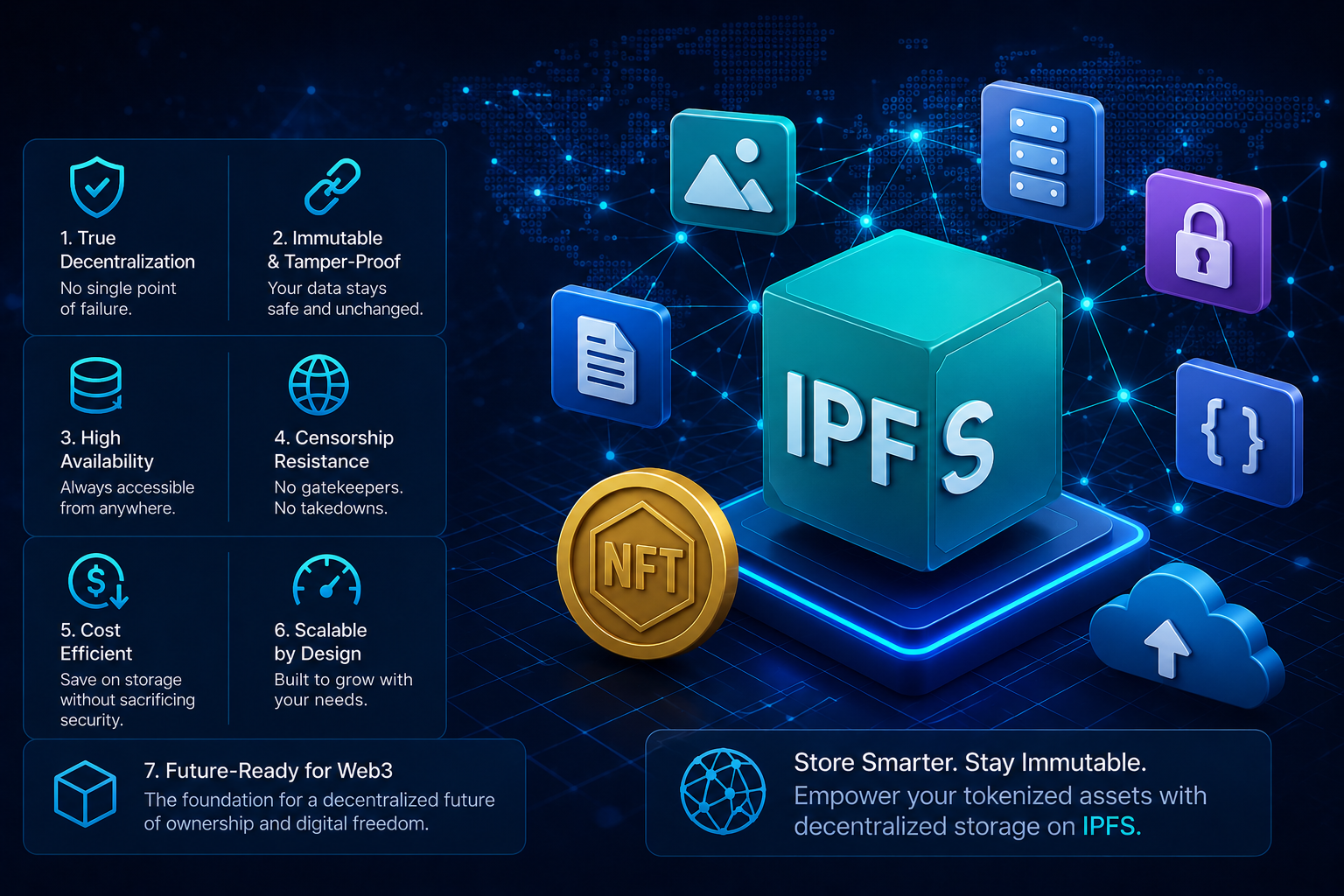
No Single Point of Failure Data is distributed across nodes, ensuring availability even if some nodes fail.
Immutable Data Once stored, content cannot be altered without changing its hash.
Permanent Access CIDs ensure that data remains accessible as long as it exists on the network.
High Resilience Distributed architecture improves uptime and reliability.
Blockchain Compatibility IPFS works alongside blockchain—storing large files off-chain while the blockchain records ownership. Read our deeper dive on what IPFS is and how it works.
Here's the key insight: blockchains do not store large files. They store ownership records and transaction history — but not images, documents, or metadata.
If your storage layer is weak, your tokenized asset becomes meaningless.
With IPFS and Decentralized Storage, you get:
Without it, even the most valuable NFT can become a broken link.
🔐 Tamper-Proof Storage Content addressing ensures that data cannot be altered without detection.
🌐 Distributed Availability Files are stored across multiple nodes, improving uptime.
⚡ Faster Retrieval Data can be fetched from the nearest node, reducing latency.
📉 Cost Efficiency Reduces dependency on expensive centralized infrastructure.
🔍 Transparency Anyone can verify the authenticity of stored data.
1. NFTs Digital art, gaming assets, and collectibles rely on IPFS for secure metadata storage. See how NFTs and asset tokenization are connected.
2. Tokenized Real-World Assets Real estate, commodities, and financial instruments need reliable storage for documentation. Explore tokenized real-world assets and their metrics.
3. Digital Identity Secure and verifiable identity systems depend on immutable data.
4. Document Verification Certificates, contracts, and records can be stored permanently and securely. Learn how financial asset tokenization uses secure off-chain storage for document integrity.
IPFS is not just an alternative—it's a foundational layer for Web3. It enables off-chain storage for scalability, secure data sharing, and decentralized application (dApp) functionality.
Without decentralized storage, Web3 cannot truly be decentralized. This is why Spydra's platform is built with IPFS support baked into the network deployment process.
While IPFS is powerful, implementing it at scale can be complex. That's where Spydra's IPFS solution comes in.
Why Choose Spydra?
👉 Explore Spydra IPFS Solution
Spydra bridges the gap between powerful decentralized storage and real-world usability. See how businesses are already using Spydra in our comprehensive asset tokenization guide.
The future is clear: decentralized systems will dominate. As Web3 grows, more assets will be tokenized, data integrity will become critical, and trustless systems will be the norm.
IPFS is set to become a core infrastructure layer, just like cloud computing today. Spydra is already enabling enterprises to tokenize and manage real-world assets on public chain with this infrastructure built in.
1. What is IPFS and how does it work?
IPFS is a decentralized file storage system that uses cryptographic hashes to identify and retrieve data instead of traditional URLs. Read the full IPFS explainer →
2. Why is centralized storage risky for NFTs?
Because if the server hosting the NFT data fails, the asset loses its value and accessibility. Learn more about NFTs and asset tokenization →
3. Can IPFS guarantee permanent storage?
IPFS ensures persistence as long as the data is pinned or hosted across nodes.
4. How does IPFS improve security?
It uses content addressing and cryptographic hashing, making data tamper-proof.
5. Is IPFS scalable for enterprise use?
Yes, especially when implemented with solutions like Spydra that provide managed infrastructure.
6. How does Spydra simplify IPFS adoption?
Spydra offers private networks, APIs, and cluster management to make deployment easy and reliable. Why Spydra? →
The promise of tokenization is powerful—but only if the underlying data is secure, accessible, and permanent. Relying on centralized storage defeats the purpose of blockchain.
By adopting IPFS and decentralized storage, you ensure long-term asset value, data integrity, and true decentralization.