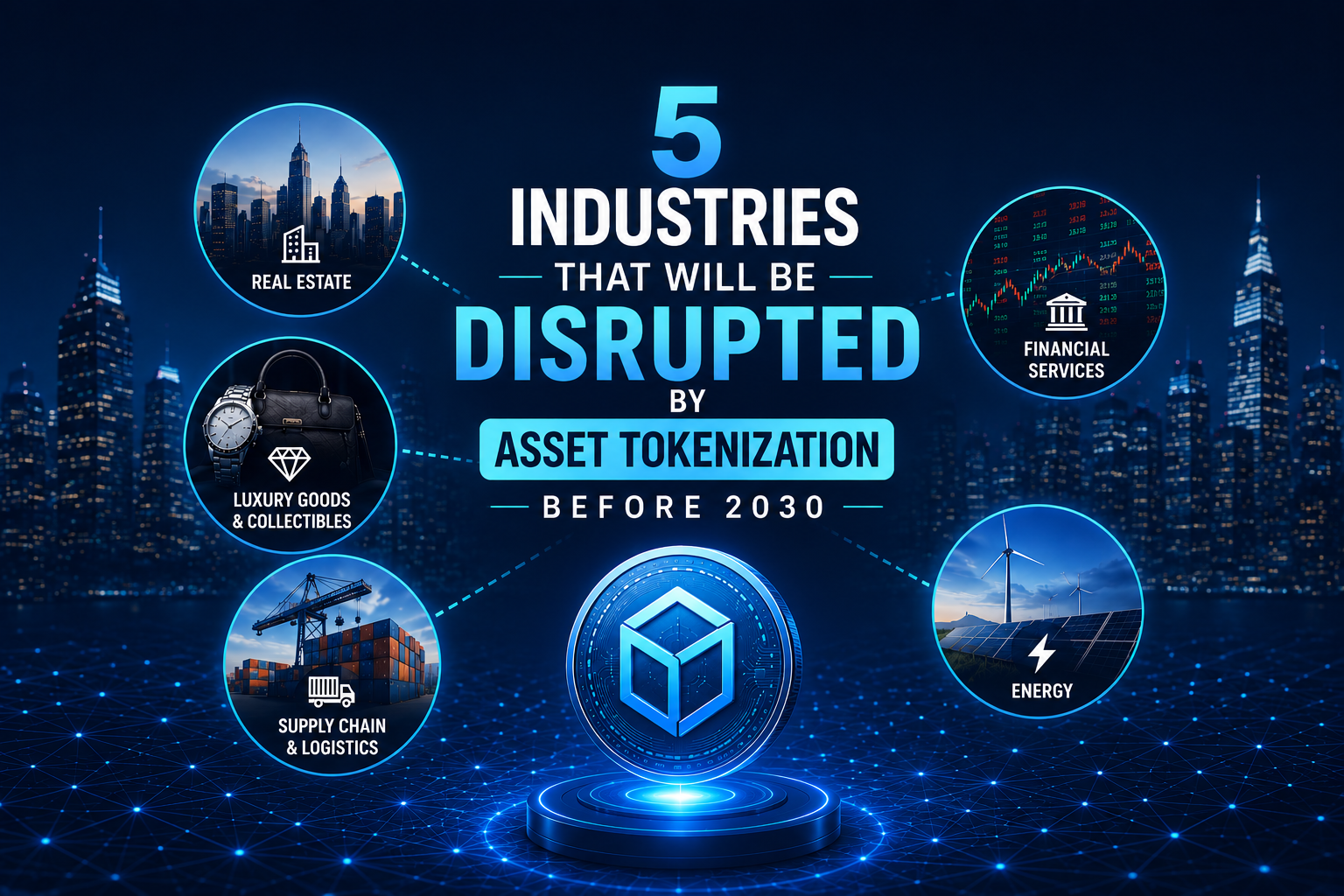
The word 'disruption' gets overused. In the context of asset tokenization, it is understated.
We are not talking about incremental efficiency gains or technology pilots. We are talking about the structural rewiring of how trillions of dollars of real-world value are owned, financed, traded, and managed. If you want the full mechanics of how this works, our guide on asset tokenization explained covers the foundations — this article focuses on the industries where the impact will be deepest and fastest.
The numbers frame the scale. The asset tokenization market was valued at $2.08 trillion in 2025 and is forecast to reach $18.74 trillion by 2031 at a CAGR of 44.25%. BCG and ADDX project a $16 trillion opportunity by 2030. Over 60% of US and European asset managers already plan to offer tokenized products. This is not a future trend — it is an accelerating present.
Regulatory momentum is accelerating this further. India's Asset Tokenization Bill 2026 marks a landmark shift in digital investment laws, while South Korea, the EU, and Singapore are all moving toward formal tokenized asset frameworks. The policy window is opening globally and simultaneously.
The question for enterprises is not whether tokenization will disrupt their industry. It is whether they will lead that disruption or be disrupted by those who do.
Real estate is the world's largest asset class — valued at approximately $330 trillion globally. It is also one of the most illiquid, inaccessible, and friction-laden investment categories in existence. Buying commercial real estate in Mumbai, London, or New York requires millions in capital, months of legal due diligence, and armies of intermediaries. Tokenization changes every single one of these constraints.
Real estate currently accounts for 30.12% of the asset tokenization market — the largest single asset class. Bergen County in New Jersey is already digitizing $240 billion worth of property deeds by bringing 370,000 real estate titles onto blockchain. NYSE and Securitize's recent moves — covered in our post on
NYSE and Securitize Accelerating the Rise of Tokenized Securities — signal that institutional-grade secondary market infrastructure is being built for tokenized real estate right now.
"Tokenized real estate is no longer a pilot programme — it is becoming the primary infrastructure for institutional real estate investment."
— Deloitte Center for Financial Services, 2025
India's real estate market — valued at over $500 billion and projected to reach $1 trillion by 2030 — faces exactly the structural problems tokenization solves. India's newly introduced Asset Tokenization Bill 2026 provides the regulatory foundation for compliant property token issuance. Foreign investment in Indian real estate has been limited by regulatory friction and opacity of land records. Tokenization, combined with this evolving legal framework, creates a pathway for global institutional capital to enter Indian commercial real estate for the first time at scale.
Spydra for Real Estate: Token Engine for fractional issuance, automated rental income distribution, KYC/AML-gated transfer controls.
→ Explore Spydra's Real Estate Tokenization solution
Global supply chains trap approximately $2 trillion in working capital at any given moment — locked in unpaid invoices, delayed payment cycles, and opaque financing arrangements. Small and medium suppliers wait 60–120 days for payment on goods already delivered. Traditional supply chain finance solutions are slow, paper-dependent, and limited to suppliers with existing banking relationships.
Our dedicated post on Unlocking Deep Tier Supply Chain Financing with Blockchain dives into exactly how multi-tier supplier networks — not just first-tier suppliers — can benefit from on-chain finance.
India's supply chain finance market is one of the largest and most underpenetrated in the world. The OCEN (Open Credit Enablement Network) framework—in which Spydra is an active participant—creates standardized digital lending infrastructure for supply chain finance across India. Tokenization on top of OCEN rails means any verified supplier, regardless of size or geography, can access institutional-grade financing against their verified on-chain invoice assets.
The global pharmaceutical supply chain loses an estimated $200 billion annually to counterfeit drugs. The WHO estimates 1 in 10 medicines in low- and middle-income countries is substandard or falsified. Clinical trial data fraud costs the industry billions. Patient record fragmentation prevents effective care coordination.
Healthcare is an industry where the cost of opacity is not measured in dollars alone — it is measured in lives. Blockchain tokenization of pharmaceutical assets, clinical data, and supply chain events creates a trustworthy, tamper-proof, globally accessible record that has never existed before.
Venture capital investment in blockchain healthcare hit $2.5 billion in 2023. Healthcare providers and insurers invested nearly $1 billion in blockchain infrastructure for billing and claims platforms by 2025. The blockchain in healthcare market is growing at over 20% annually. A 264% surge in ransomware attacks in 2024 accelerated blockchain adoption significantly.
The global insurance industry is a $7 trillion market built on a 300-year-old model: manual underwriting, opaque pricing, adversarial claims processes, and structural information asymmetry between insurer and insured. Claims processing averages 30+ days in many markets. Fraud costs the global insurance industry $80 billion annually. And access to insurance is fundamentally limited in emerging markets where underwriting data is scarce.
Tokenization is not incrementally improving this model. It is replacing it with parametric insurance powered by smart contracts, oracle-verified triggers, and tokenized risk pools.
"Blockchain has joined forces with the reinsurance sector to bring sufficient liquidity to the asset class, and a whole new avenue for alternative capital to enter the industry."
— Ted Georgas, Co-founder & CTO, OnRe, 2025
India's insurance penetration stands at approximately 4% of GDP. The primary barrier is not affordability — it is the cost of distribution, claims processing, and fraud management that makes small-ticket insurance commercially unviable for traditional insurers. Tokenized parametric insurance with automated claims settlement fundamentally changes this economics. The CBDC infrastructure Spydra has built for Indian banks could also serve as the payment rail for instant insurance claim settlements — creating a seamless digital insurance ecosystem.
The voluntary carbon market is plagued by double-counting, fraudulent project claims, and inadequate verification. High-profile scandals have exposed certification bodies for issuing credits that significantly overstate actual emissions reductions. The result is a market that should be a critical mechanism for financing the green transition but is instead mired in credibility questions.
Beyond carbon, the broader ESG investment universe — $50 trillion of assets managed under ESG mandates globally — suffers from greenwashing. Without verifiable, tamper-proof data underlying ESG claims, sustainable finance is built on sand. We first explored the intersection of blockchain and sustainability in our post from COP28 UAE and Blockchain: Catalyst for Sustainable Climate Finance — the developments since have only accelerated.
Commodities tokenization — which includes carbon credits and precious metals—is posting the fastest growth trajectory in the entire asset tokenization market, with a 48.35% CAGR through 2031. The voluntary carbon market is projected to reach $50 billion by 2030 — but only if credibility and liquidity problems are solved. Tokenization is the solution.
India has committed to net-zero emissions by 2070 and is developing carbon trading infrastructure through SEBI and the Bureau of Energy Efficiency. India's domestic carbon market will require exactly the kind of trustworthy, transparent, and fraud-resistant infrastructure that blockchain tokenization provides. The CBDC Digital Rupee infrastructure being piloted for welfare programs in Puducherry demonstrates how India is building the digital payment rails that carbon credit tokenization will run on.
Not all five industries will be disrupted on the same timeline. Here is an assessment of where each stands today and where it will be by 2030.
The pilot phase of enterprise tokenization is over. The enterprises winning today — Raymond, Bajaj Finserv, Mother Dairy, Myntra — are running production systems, not proofs of concept. The gap between enterprises with live tokenization infrastructure and those still evaluating pilots will compound over the next four years. If you're still debating whether blockchain is ready for enterprise use, our analysis of how blockchain rescued businesses in 2025 provides concrete evidence that it already has.
Not all tokenization platforms are equal. The critical requirements: permissioned network capability, public chain support, no-code tooling, proven enterprise integrations, and regulatory compliance by design. Compare leading options in our guide on top asset tokenization platforms. Spydra is the only platform in India with ISO 27001 certification, native Hyperledger Fabric support, public chain capability, and production deployments across real estate, retail, finance, dairy, and insurance.
The enterprises leading tokenization disruption are not moving fast and breaking things. They are moving fast within regulatory frameworks — building KYC/AML into token architecture, engaging regulators early, and structuring programs to comply with India's evolving frameworks. The India Asset Tokenization Bill 2026 and global moves like South Korea's RWA legalisation confirm that compliance-first tokenization is the only sustainable path.
Spydra is a low-code, API-driven enterprise tokenization platform built on Hyperledger Fabric and EVM-compatible public chains. With production deployments across Raymond (supply chain finance), GS1 India / Maahi Ghee (food traceability), Bajaj Finserv (insurance and lending), Myntra (retail authentication), and top Indian banks (CBDC), Spydra is the enterprise tokenization infrastructure layer for India's digital economy.
The disruption of these five industries by asset tokenization before 2030 is not a prediction. It is an observation of what is already underway — in production, at scale, with measurable ROI.
Real estate is being fractionalized and traded 24/7. Supply chains are settling invoices in minutes. Drug provenance is being verified by QR code scan. Insurance claims are being paid by smart contract. Carbon credits are being minted and retired on-chain with cryptographic proof of uniqueness.
The enterprises leading these changes chose to build on blockchain infrastructure early. The tools exist. The regulatory frameworks are forming. The case studies are published. What remains is the decision to act. If you're ready to understand the full mechanics behind what makes this possible, start with our comprehensive guide on how asset tokenization works — and then talk to Spydra about what it looks like for your industry.
1. What is asset tokenization and how does it work?
Asset tokenization is the process of converting ownership rights of real-world assets—such as real estate, invoices, or carbon credits—into digital tokens on a blockchain. These tokens can be traded, transferred, and programmed using smart contracts.
2. Why is asset tokenization considered disruptive rather than incremental?
Because it fundamentally changes ownership structures, liquidity models, and settlement systems—replacing intermediaries with programmable infrastructure and enabling real-time, global asset markets.
3. How big is the asset tokenization market opportunity?
The market is projected to grow from ~$2 trillion in 2025 to over $16–18 trillion by 2030–2031, driven by institutional adoption and regulatory clarity.
4. Is asset tokenization legally compliant?
Yes—when built with compliance-first architecture. Frameworks like KYC/AML, securities laws, and region-specific regulations (e.g., India’s Asset Tokenization Bill 2026) are increasingly supporting tokenized assets.
5. How does tokenization improve real estate liquidity?
It enables fractional ownership and 24/7 trading on secondary markets, allowing investors to buy and sell property shares without traditional delays.
6. Can retail investors invest in tokenized real estate?
Yes, tokenization lowers entry barriers, allowing investors to participate with smaller ticket sizes instead of needing millions in capital.
7. What is invoice tokenization?
Invoice tokenization converts approved invoices into blockchain-based digital assets that can be financed instantly by lenders.
8. How does tokenization help MSMEs in supply chains?
It enables faster access to working capital by allowing small suppliers to finance invoices without relying on traditional banking relationships.
9. How does blockchain prevent counterfeit drugs?
By assigning each drug batch a unique on-chain identity and tracking every movement across the supply chain, ensuring full traceability.
10. Can patient data be tokenized securely?
Yes, patients can tokenize and control access to their health data, sharing it selectively while maintaining privacy and ownership.
11. What is parametric insurance in blockchain?
Parametric insurance uses smart contracts to automatically trigger payouts when predefined conditions (like weather events) are met.
12. How does tokenization reduce insurance fraud?
Shared, immutable records across insurers prevent duplicate claims and improve transparency without exposing sensitive data.
13. How does tokenization solve carbon credit fraud?
Each carbon credit is uniquely tokenized on-chain, eliminating double-counting and ensuring verifiable ownership and retirement.
14. What role does blockchain play in ESG reporting?
It enables real-time, tamper-proof tracking of environmental and sustainability data via IoT and oracle integrations.