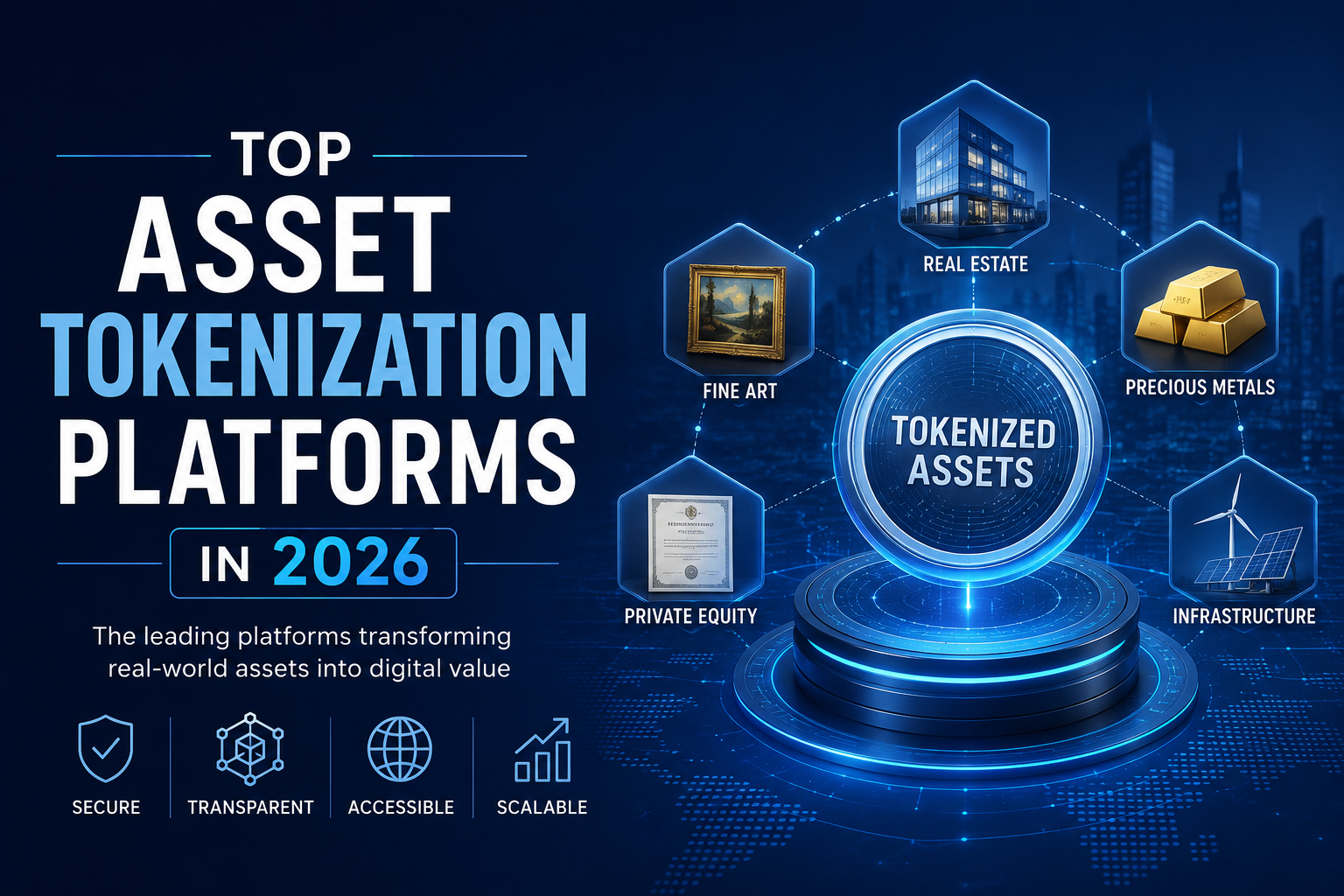
Asset tokenization has moved beyond proof-of-concept experiments and early-stage pilots. In 2026, it represents a structurally important shift in how real-world assets (RWAs) are issued, managed, traded, and settled. Real estate, private equity, private credit, commodities, carbon credits, intellectual property, funds, and even government-backed instruments are increasingly being represented as blockchain-based tokens.
With institutional adoption accelerating and regulatory clarity improving across major jurisdictions, tokenization is now viewed as a strategic infrastructure layer rather than a niche innovation. Industry forecasts suggest that tokenized real-world assets could represent trillions of dollars in value before the end of the decade, driven by demand for liquidity, fractional ownership, transparency, and faster settlement.
This guide highlights the top asset tokenization platforms in 2026, explains how to evaluate them, and outlines the trends shaping the next phase of tokenized finance.
Selecting the right tokenization platform requires aligning technical capabilities with regulatory, operational, and market requirements. In 2026, decision-makers should evaluate platforms based on the following criteria:
Platforms must support KYC/AML workflows, jurisdiction-specific compliance rules, investor eligibility controls, and auditability. Built-in compliance tooling is no longer optional, especially for institutional and enterprise use cases.
Leading platforms now support a wide range of assets including equity, debt, real estate, funds, commodities, ESG-linked assets, carbon credits, and intellectual property. Flexibility across asset classes is a key differentiator.
Hybrid models that combine permissioned enterprise networks with public blockchain liquidity are becoming the standard. Platforms should support both environments without compromising security or compliance.
The ability to enable secondary trading, integrate with marketplaces, or support peer-to-peer transfers significantly impacts asset attractiveness and investor participation.
Modern tokenization platforms provide APIs, SDKs, and no-code or low-code interfaces that reduce implementation time and operational complexity.
Institution-grade security, audited smart contracts, multi-party computation (MPC), and secure custody integrations are essential for protecting tokenized assets at scale.
Why It Stands Out: Spydra’s OpenRWA is a powerful enterprise-ready platform designed for institutions, startups, and governments seeking compliant and modular tokenization. It offers tokenization across both public and private blockchains.
Key Highlights:
Best For: Businesses needing full control over asset tokenization, with flexibility across blockchain networks.
Why It Stands Out: As a registered SEC transfer agent, Securitize is a pioneer in compliant digital securities. It provides institutional-grade tools for issuing and managing tokenized assets.
Key Highlights:
Best For: Asset managers and enterprises in regulated environments, particularly in the U.S.
Why It Stands Out: Based in Europe, Tokeny focuses on institutional tokenization with an emphasis on compliance, interoperability, and global scalability.
Key Highlights:
Best For: European institutions and global asset issuers seeking interoperability and trust.
Why It Stands Out: tZERO bridges traditional finance and blockchain by offering regulated trading for tokenized securities through its SEC-compliant ATS.
Key Highlights:
Best For: Companies seeking regulated token issuance and active secondary market participation.
Why It Stands Out: Fireblocks is the leading provider of secure infrastructure for digital asset custody, token issuance, and transfer. It powers many institutional tokenization platforms behind the scenes.
Key Highlights:
Best For: Institutions looking to tokenize assets while ensuring custody-grade security.
Why It Stands Out: RealT simplifies fractional real estate investing by offering blockchain-based property tokens backed by real-world income.
Key Highlights:
Best For: Global retail investors seeking income-generating real estate exposure.
Why It Stands Out: Kaleido is a Blockchain-as-a-Service (BaaS) platform designed for enterprise-grade applications. Its tokenization suite is built for rapid asset deployment with minimal technical barriers.
Key Highlights:
Best For: Enterprises seeking rapid tokenization with enterprise integrations.
Why It Stands Out: Ondo brings traditional finance (TradFi) yield strategies to Web3 by tokenizing financial instruments like bonds and treasuries.
Key Highlights:
Best For: Investors and protocols looking for on-chain fixed-income exposure and structured yield.
9. Harbor
Why It Stands Out: Harbor focuses on compliance-first tokenization of private securities, ensuring regulatory alignment from issuance to transfer.
Key Highlights:
Best For: Private asset managers needing a full-stack compliant tokenization solution.
Why It Stands Out: Polymath created the Polymesh blockchain—purpose-built for security tokens. It removes regulatory uncertainty by embedding compliance into the protocol.
Key Highlights:
Best For: Issuers needing blockchain-native compliance and control over security token issuance.
Why It Stands Out: Propy is a blockchain-based platform that offers a complete solution for real estate transactions, including tokenization. They are known for their innovative approach to real estate, making them a leader in the industry.
Key Highlights:
Best For: Investors interested in a streamlined, blockchain-based real estate transaction experience.
Why It Stands Out: BrickBlock offers a robust real estate tokenization platform that caters to both individual and institutional investors. Their platform is known for its transparency, security, and ease of use, making it a top choice for many investors.
Key Highlights:
Best For: Investors seeking a secure and transparent platform for real estate tokenization.
Why It Stands Out: Slice allows investors to invest in fractional ownership of large commercial properties, such as office buildings and shopping malls. This is a unique offering, as most real estate tokenization platforms focus on smaller properties, such as single-family homes and apartments.
Key Highlights:
Best For: Investors looking for exposure to large-scale commercial real estate with high liquidity.
Why It Stands Out: Reido is governed by a DAO (decentralized autonomous organization), which means that users have a say in the development and operation of the platform. This helps to ensure that the platform is aligned with the interests of its users.
Key Highlights:
Best For: Investors seeking a community-driven approach to real estate investment with enhanced liquidity.
Why It Stands Out: SolidBlock is a prominent real estate tokenization platform that uses digital title deeds to simplify the real estate transaction process. Digital title deeds are stored on a blockchain, which makes them tamper-proof and secure.
Key Highlights:
Best For: Investors looking for a regulated and secure platform for real estate tokenization.
Tokenized stocks have become one of the fastest-growing categories within asset tokenization. Instead of holding shares through a traditional broker, investors can hold blockchain-based tokens that mirror the price and economic exposure of real equities and ETFs. By late 2025, tokenized equities had grown into a market worth hundreds of millions of dollars in on-chain value, with adoption accelerating sharply into 2026.
There are two main models:
For a platform to issue tokenized stocks compliantly in 2026, it must combine real-time data feeds, programmable compliance, secure custody, and lifecycle management in one place. This is exactly where an enterprise-grade infrastructure layer matters: Spydra's [Token Engine INTERNAL LINK] lets businesses fractionalize and issue tokens against assets, while the built-in [Oracle INTERNAL LINK] brings off-chain price and corporate-action data on-chain — the core building blocks for any tokenized equity product. With support for both public and private networks, enterprises can launch compliant tokenized financial products under their own brand rather than depending on a third-party issuer.
For U.S.-based investing, the tokenized landscape in 2026 is shaped heavily by regulation. Because tokenized equities are generally treated as securities, any app or platform serving American users must operate through registered broker-dealers, transfer agents, or compliant partners.
Whether you're building a tokenized investing product or evaluating one, these are the qualities that matter most:
For businesses and fintechs that want to launch tokenized investing products for the U.S. market, the challenge is rarely the front-end app — it's the compliant infrastructure underneath. Spydra provides a compliance-first foundation with programmable KYC/AML rules, investor controls, and multi-asset support, so teams can build investor-facing apps on top of infrastructure that's built for regulated environments.
Note: Tokenized-asset regulation evolves quickly. Always confirm current eligibility rules and consult a licensed professional before launching or investing.
Beyond issuing tokens, enterprises need full digital asset management — the ability to onboard, track, value, transfer, and report on tokenized assets across their entire lifecycle. In 2026, the best tokenization services combine issuance with ongoing management, compliance, and custody in a single integrated stack.
Strong digital asset management services in 2026 deliver:
Spydra (OpenRWA) is built precisely for this. It offers end-to-end lifecycle management from onboarding to payout, compliance-first programmable rules, multi-asset tokenization across equity, debt, real estate, and more, plus [Analytics INTERNAL LINK] and [Asset Data INTERNAL LINK] tools that give enterprises complete visibility into their tokenized portfolios — all through modular APIs and no-code interfaces.
Organizations entering tokenization face an early decision: build an asset tokenization platform in-house or adopt an existing infrastructure provider.
Building in-house gives maximum control but requires heavy investment in:
Buying or partnering dramatically reduces time-to-market and engineering risk. For most enterprises in 2026, a hybrid approach wins: use a flexible, blockchain-agnostic provider for core issuance, compliance, and lifecycle management, then customize the parts unique to your business.
This is Spydra's core strength. As an API-driven, blockchain-agnostic platform with [Custom Chaincode INTERNAL LINK], modular APIs, and no-code [Workflows INTERNAL LINK], Spydra lets teams launch tokenized products in weeks instead of months—delivering the speed of buying with the control of building.
[Book a demo INTERNAL LINK] or [get started INTERNAL LINK] to scope your tokenization build.
Asset tokenization in 2026 is no longer a niche innovation—it’s a foundational shift in how assets are issued, managed, and traded. The platforms listed above are driving this evolution by offering innovative features, regulatory safeguards, and infrastructure needed to scale tokenized markets globally.
What to Expect in 2026 and Beyond:
While asset tokenization platforms are transforming traditional finance, they also come with a set of operational and regulatory challenges that enterprises must address.
1. Regulatory Uncertainty:
The biggest challenge lies in navigating evolving regulations. Some jurisdictions still classify tokenized assets as securities, creating compliance hurdles. Staying updated with frameworks like MiCA (EU) and SEC tokenized asset rules is crucial.
2. Liquidity Limitations:
Tokenization doesn’t automatically ensure liquidity. Establishing secondary trading options or integrating with decentralized exchanges can improve post-issuance liquidity.
3. Technological Complexity:
Integrating blockchain layers, custodial services, and oracles can be technically demanding. Partnering with enterprise-grade providers like Spydra simplifies this with modular APIs and blockchain-agnostic support.
4. Data Privacy and Security:
Since tokenized assets often represent sensitive financial or ownership data, maintaining encryption, on-chain privacy, and access controls is vital.
5. Market Adoption and Education:
Many investors and institutions are still learning about the benefits of tokenized assets. Education and trust-building will accelerate mainstream adoption.
In summary: Overcoming these challenges requires a blend of strong compliance, flexible technology, and a reliable platform partner.
The future of asset tokenization platforms lies in interoperability and global standardization.
As tokenized financial markets mature, we’ll see cross-chain token movement, institutional-grade custody, and AI-driven asset management tools.
According to Boston Consulting Group (BCG), the tokenization market could reach $16 trillion by 2030, driven by real-world assets like real estate, bonds, and infrastructure.
Platforms like Spydra are leading this transition — offering scalable, compliant, and interoperable tokenization infrastructure that empowers enterprises to unlock liquidity and broaden investor participation worldwide.
The asset tokenization ecosystem is growing fast, and 2026 is shaping up to be a breakout year. Whether you're a traditional institution or a blockchain-native startup, these platforms offer the infrastructure, compliance, and innovation needed to launch successful tokenized products. Choose based on your industry, asset type, and compliance needs—and join the future of finance.
A1: Asset tokenization is the process of converting ownership rights of real-world assets, such as real estate, equity, or commodities, into digital tokens on a blockchain. This approach enhances liquidity, enables fractional ownership, and broadens access to investment opportunities.
A2: Selecting the appropriate platform depends on factors like asset type, regulatory requirements, geographic focus, and desired features. Platforms like Spydra offer modular solutions with compliance-first approaches, while Securitize provides SEC-compliant tools for U.S.-based assets.
A3: The legality of asset tokenization varies by jurisdiction. In the U.S., platforms like Securitize operate under SEC regulations, ensuring compliance. It's essential to consult with legal professionals to understand the regulatory landscape in your region.
A4: Yes, platforms like Spydra specialize in tokenizing real estate properties, allowing fractional ownership and income distribution through blockchain technology.