Global derivatives markets process trillions in notional value, yet much of the underlying infrastructure still relies on fragmented systems, manual reconciliation, and delayed settlement cycles. For enterprises operating at scale, these inefficiencies translate into higher operational costs, increased counterparty risk, and regulatory complexity.
This is where blockchain in derivatives emerges as a transformative force. By enabling shared, tamper-proof ledgers and programmable workflows, blockchain is redefining how derivatives are created, executed, managed, and settled.
Enterprises adopting blockchain in derivatives are not merely upgrading technology—they are reengineering financial operations for speed, transparency, and resilience.
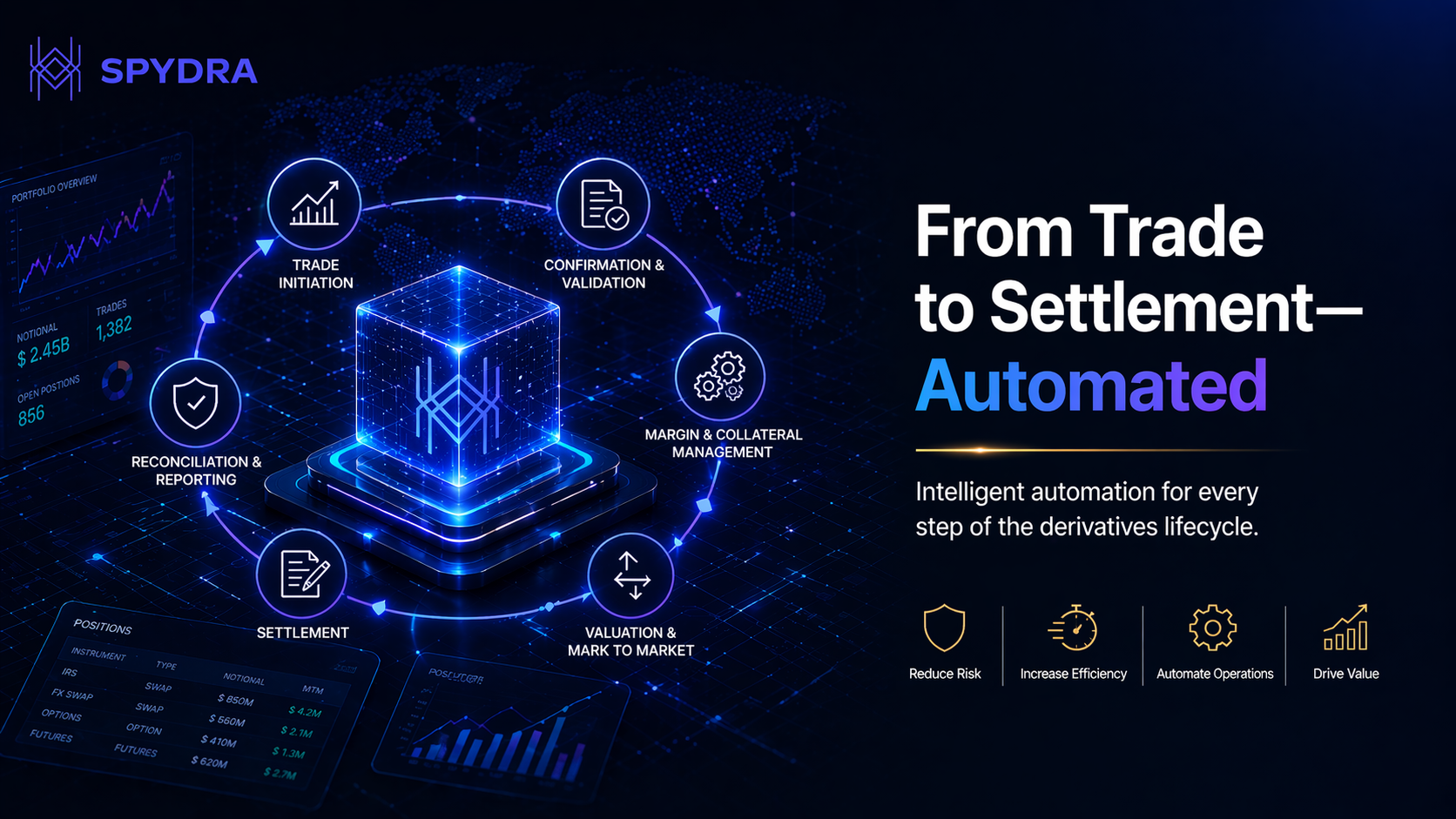
Derivatives lifecycle management refers to the end-to-end processes involved in handling a derivatives contract. This lifecycle typically includes:
Traditional systems manage these stages across siloed platforms, often leading to inconsistencies and delays. Implementing blockchain in derivatives introduces a unified infrastructure that synchronizes data across all participants.
Despite technological advancements, derivatives markets still face structural inefficiencies:
Multiple intermediaries maintain separate records, increasing reconciliation efforts.
Heavy reliance on manual verification slows down operations and increases error rates.
T+2 or longer settlement cycles lock up capital and elevate risk exposure.
Limited transparency makes it difficult to assess real-time exposure.
Complex reporting requirements demand consistent, auditable data.
Adopting blockchain in derivatives directly addresses these issues by creating a single source of truth accessible to all authorized participants.
With shared ledgers, market participants gain access to real-time data, improving price discovery and risk evaluation.
Smart contracts automate trade execution by embedding contractual terms directly into code. In blockchain in derivatives, this reduces reliance on intermediaries and ensures deterministic outcomes.
Reconciliation becomes obsolete as all parties interact with the same immutable ledger. This is one of the most immediate benefits of blockchain in derivatives.
Blockchain enables near-instant settlement (T+0), significantly reducing capital lock-up and counterparty exposure.
Every transaction is time-stamped and traceable, simplifying compliance and audit processes.
Over-the-counter derivatives often involve complex, customized contracts. Using blockchain in derivatives, enterprises can standardize workflows while maintaining flexibility.
Smart contracts can automatically trigger margin calls based on real-time market data, improving capital efficiency.
Blockchain eliminates intermediaries in cross-border transactions, reducing costs and delays.
By integrating tokenized assets, institutions can create more liquid and accessible derivatives products.
Enterprises leveraging blockchain in derivatives gain measurable advantages:
These benefits collectively enhance institutional competitiveness in increasingly digital markets.
Implementing blockchain in derivatives requires a robust architectural approach:
Platforms like Hyperledger Fabric enable controlled access, ensuring privacy and compliance.
APIs connect blockchain systems with existing trading, risk, and compliance platforms.
Defines business logic, automating trade execution and lifecycle events.
Represents assets digitally, enabling seamless transfer and settlement.
Provides real-time market data for pricing and contract execution.
This modular architecture allows enterprises to adopt blockchain in derivatives without disrupting legacy systems.
Identify high-impact use cases and evaluate ROI potential.
Test blockchain solutions in controlled environments.
Connect blockchain infrastructure with existing enterprise systems.
Expand deployment across business units and geographies.
Enterprises that strategically implement blockchain in derivatives can achieve faster time-to-value and reduced implementation risk.
While promising, adoption comes with challenges:
Global regulations around blockchain and derivatives are still evolving.
Different blockchain platforms must communicate seamlessly.
Sensitive financial data must be securely managed.
Transitioning from legacy systems requires organizational alignment.
Despite these challenges, the long-term value of blockchain in derivatives outweighs the initial complexity.
The adoption of blockchain in derivatives is accelerating as institutions recognize its strategic value. Key trends include:
As infrastructure matures, blockchain in derivatives will become a foundational component of modern financial systems.
The derivatives market is at a critical inflection point. Enterprises that embrace blockchain in derivatives can unlock new levels of efficiency, transparency, and innovation.
By streamlining lifecycle management—from trade execution to settlement—blockchain enables institutions to reduce costs, mitigate risks, and improve operational agility.
Platforms like Spydra empower enterprises to implement these capabilities through scalable tokenization and blockchain solutions tailored for capital markets.