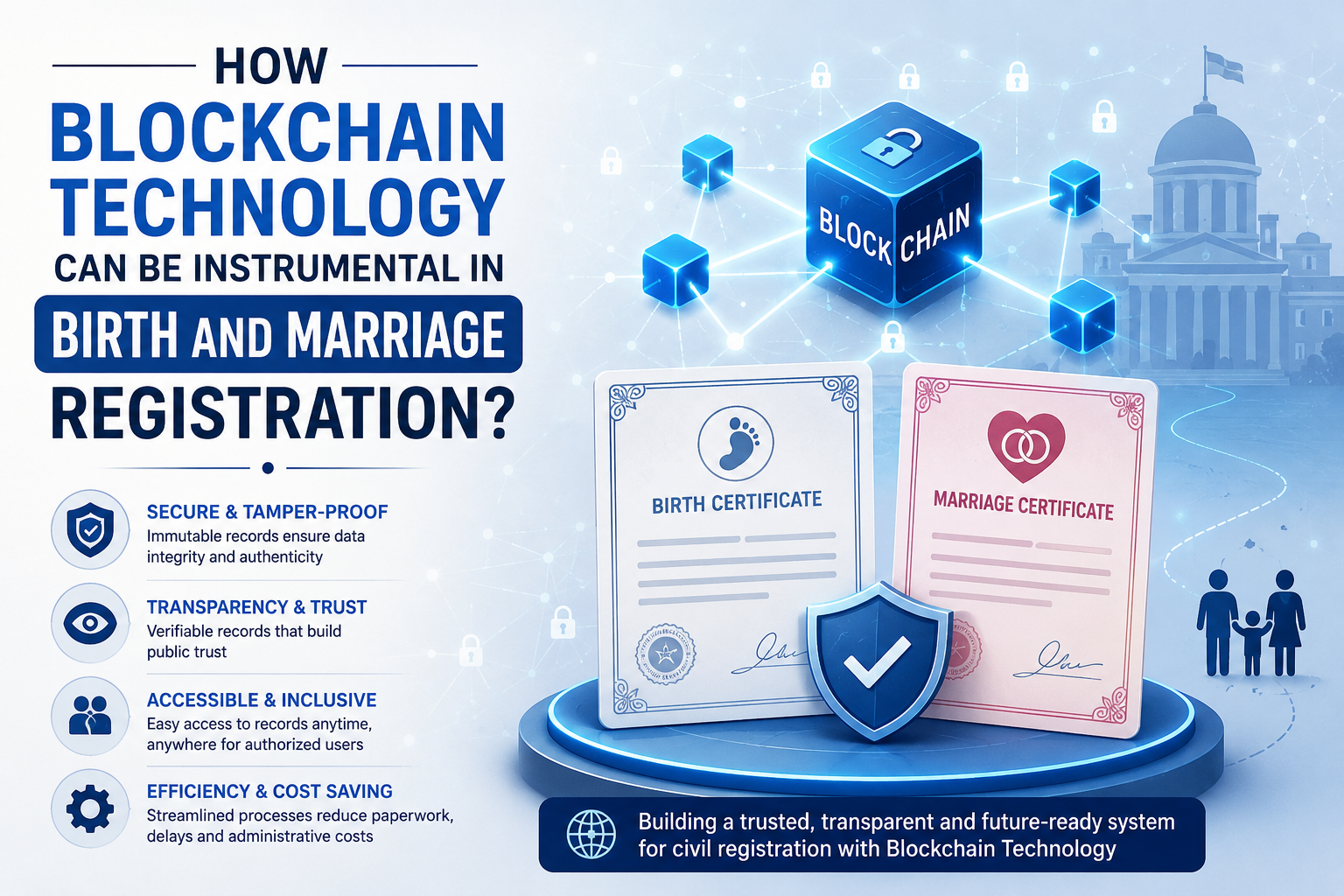
Birth and marriage certificates are among the most important legal identity documents issued by governments. They are essential for accessing healthcare, education, banking, inheritance rights, passports, and numerous public services. However, many civil registration systems across the world still rely on fragmented databases, paper-based documentation, and manual verification processes.
These traditional systems often face serious challenges, including document fraud, record tampering, administrative delays, data loss, and limited accessibility for citizens.
Blockchain technology is emerging as a powerful solution to modernize civil registration infrastructure. By enabling secure, tamper-proof, and transparent digital record management, blockchain can help governments build more efficient and trustworthy birth and marriage registration systems.
In this article, we explore how blockchain is transforming civil registration, its benefits, real-world applications, challenges, and the future of decentralized identity systems.
Blockchain is a decentralized digital ledger that records transactions and data across a distributed network of computers. Once information is added to the blockchain, it becomes extremely difficult to alter or delete, creating a permanent and verifiable record.
Key characteristics of blockchain include:
These features make blockchain highly suitable for managing sensitive government records such as birth and marriage certificates.
Many government registration systems still depend heavily on centralized databases and physical paperwork. While these methods have worked for decades, they create several operational and security challenges.
Fake birth and marriage certificates remain a major issue in many regions, leading to identity theft, illegal immigration, and financial fraud.
Centralized systems are vulnerable to unauthorized modifications, corruption, or cyberattacks.
Citizens often wait days or weeks for document verification due to manual workflows and interdepartmental inefficiencies.
Paper-based records can be damaged, misplaced, or destroyed because of disasters, poor storage conditions, or administrative errors.
Different government departments frequently operate in silos, making secure data sharing difficult.
Citizens in remote or rural areas may struggle to access registration offices or retrieve official documents.
These issues highlight the need for more secure, scalable, and digitally accessible registration infrastructure.
Blockchain enables governments to create a secure digital framework for managing civil records.
Birth or marriage information is submitted digitally through authorized government portals or registration centers.
Officials verify supporting documents and identity credentials before approval.
A unique cryptographic hash is created for the record, ensuring integrity and preventing unauthorized changes.
The verified record is stored on a permissioned blockchain network accessible only to authorized participants.
Smart contracts automate validation rules, approvals, and audit tracking.
Citizens receive digitally verifiable certificates that can be securely shared or validated online.
Blockchain records are immutable, making it extremely difficult to forge or manipulate certificates. Each record has a verifiable digital signature and timestamp.
This significantly reduces:
Authorities, hospitals, embassies, banks, and educational institutions can instantly verify documents through blockchain-based systems without lengthy manual checks.
This accelerates:
Blockchain uses cryptographic encryption and distributed storage to protect sensitive citizen information from cyberattacks or unauthorized access.
Permissioned blockchain networks also enable role-based access control for government departments.
Digital certificates can be accessed remotely through secure digital identity systems, reducing dependency on physical documents and in-person visits.
This is especially valuable for:
Automation through smart contracts minimizes paperwork, manual processing, and repetitive verification workflows.
Governments can reduce operational overhead while improving efficiency.
Distributed blockchain storage reduces the risk of permanent data loss caused by natural disasters, hardware failures, or physical document deterioration.
Modern blockchain registration systems are increasingly integrated with decentralized identity (DID) frameworks.
DIDs allow individuals to securely manage and control their digital identity credentials without relying entirely on centralized authorities.
For example:
This approach enhances:
Estonia is widely recognized for its advanced digital governance infrastructure. The country has implemented secure digital identity systems that enable citizens to access numerous government services online.
India has accelerated digitization across public services through initiatives involving digital identity infrastructure and online certificate management systems.
Blockchain can further strengthen these efforts by improving transparency and fraud prevention.
The UAE has actively explored blockchain adoption for government services to improve operational efficiency and digital trust.
While blockchain offers strong security benefits, governments must also address privacy and regulatory compliance.
Important considerations include:
Most government implementations use permissioned blockchains instead of fully public networks to maintain privacy and governance control.
Despite its potential, blockchain adoption in civil registration also faces several obstacles.
Legal recognition of blockchain-based certificates varies across jurisdictions.
Many governments still operate on outdated IT infrastructure that may not easily integrate with blockchain networks.
Initial deployment costs for nationwide blockchain systems can be significant.
Citizens and government employees may require training to use digital identity platforms effectively.
Clear policies are required to define:
As governments continue modernizing public infrastructure, blockchain is expected to play a growing role in digital identity management and secure recordkeeping.
Future innovations may include:
Blockchain will likely become a foundational layer for next-generation digital governance systems.
Platforms like Spydra help organizations and governments build enterprise-grade blockchain applications with faster deployment and lower infrastructure complexity.
Using blockchain APIs, smart contracts, permissioned networks, and decentralized identity capabilities, organizations can create scalable civil registration solutions that are secure, transparent, and future-ready.
Blockchain technology has the potential to fundamentally transform birth and marriage registration systems by making records more secure, accessible, and tamper-proof.
By reducing fraud, improving verification speed, enabling digital identity integration, and enhancing transparency, blockchain can help governments modernize civil registration infrastructure for the digital age.
As adoption grows, blockchain-based registration systems may become a critical component of global digital governance and citizen identity management.