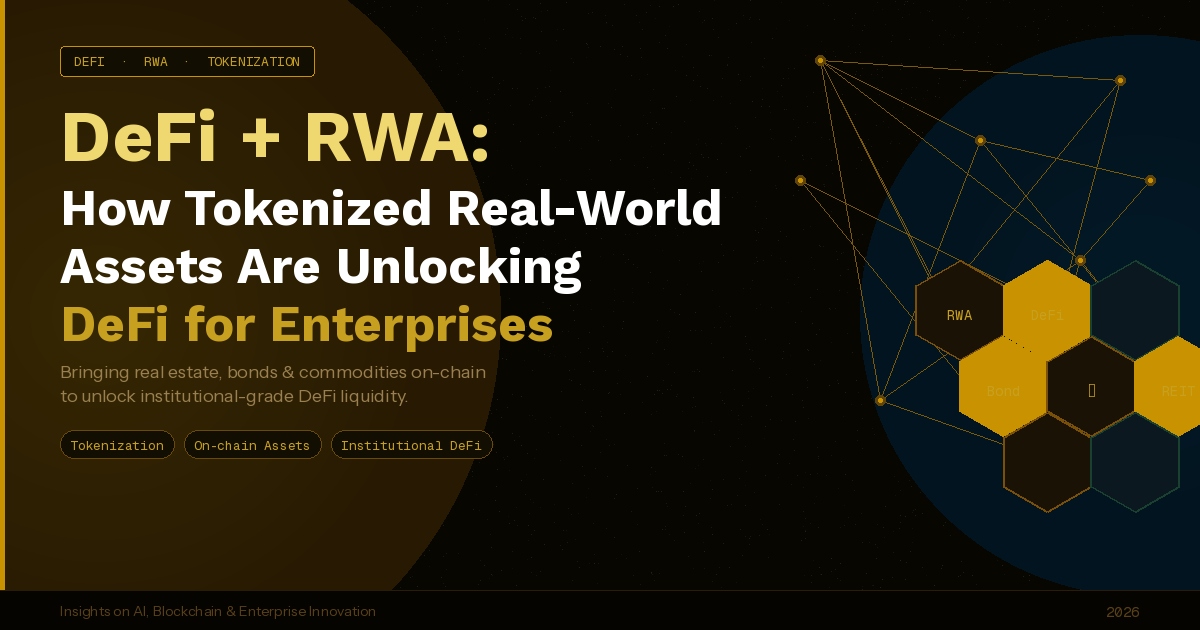
For years, decentralized finance (DeFi) operated in a bubble — a high-yield, high-risk playground built on volatile crypto-native collateral. Meanwhile, trillions of dollars in real-world assets sat locked in illiquid, paperwork-heavy traditional systems. In 2026, those two worlds are finally merging.
DeFi tokenization — the process of bringing real-world assets (RWAs) onto blockchain rails and plugging them into DeFi protocols — is no longer a fringe experiment. It is the fastest-growing segment of the on-chain economy. Industry estimates place the tokenized RWA market (excluding stablecoins) at $19–$36 billion in early 2026, with projections exceeding $100 billion by year-end (KuCoin Research, Bitfinex). Boston Consulting Group projects the market could reach $18.9 trillion by 2033 as regulatory frameworks mature and institutional adoption accelerates.
For enterprises, this convergence represents a rare opportunity: access to global liquidity pools, 24/7 trading, programmable compliance, and new capital formation pathways — all without abandoning the assets they already own.
This guide explains exactly what DeFi tokenization is, why it matters for enterprises, and — critically — how to tokenize real-world assets for DeFi, step by step.
Key stat:
BCG projects the tokenized asset market could reach $18.9 trillion by 2033. Enterprises that build the infrastructure now will own the rails that global capital flows through tomorrow.
DeFi tokenization is the process of converting ownership rights in a real-world asset into a blockchain-based digital token, then deploying that token into decentralized finance protocols — lending platforms, liquidity pools, yield vaults, or secondary markets — to unlock economic value.
It sits at the intersection of two powerful trends:
The result is a programmable financial instrument that can be held, traded, used as collateral, or split into fractional units — all with automated compliance rules baked into the token itself.
Standard asset tokenization creates a digital record of ownership on-chain but stops there. DeFi tokenization goes further: the token is not just a certificate. It is a live financial instrument that can interact with smart contracts, accrue yield, be borrowed against, or move across DeFi ecosystems autonomously. The asset becomes programmable money.
The question is no longer whether to tokenize. For forward-looking enterprises, it is whether to move fast enough to capture first-mover advantage. Here is what is driving the urgency:
Traditional assets — real estate, private credit, infrastructure bonds, inventory — are notoriously illiquid. Tokenizing them and deploying into DeFi liquidity pools means an enterprise can access capital against those assets without selling them. This is the equivalent of collateralized borrowing, but faster, cheaper, and globally accessible.
DeFi protocols run continuously. Tokenized assets on public chains can be traded, lent, and borrowed against at any hour, on any day, by investors anywhere in the world. This is fundamentally different from traditional markets constrained by geography, business hours, and settlement delays.
DeFi in 2026 has shifted from inflationary token rewards to 'real yield' — returns generated by actual protocol fees, lending interest, and underlying asset productivity. Tokenized RWAs such as government treasuries now provide the stable risk-free rate that DeFi was previously missing, creating yield products that institutional capital is actively seeking.
Modern token standards like ERC-3643 (T-REX) allow compliance rules to be embedded directly into the token. Transfer restrictions, KYC/AML requirements, jurisdictional limitations, and investor accreditation checks are enforced automatically by smart contracts — eliminating the manual compliance overhead that makes traditional asset management expensive.
Boston Consulting Group projects the tokenized asset market could reach $18.9 trillion by 2033, driven by improved liquidity, reduced friction costs, and access to new investor pools. Enterprises entering DeFi tokenization now are positioning themselves at the center of this value creation.
Successfully bringing real-world assets into DeFi requires a three-layer technical and legal architecture. Understanding these layers is essential before attempting to tokenize any asset.
This layer handles everything that makes the token legally valid and regulatory-compliant. It includes:
Since RWAs exist off-chain, DeFi protocols need a trustworthy bridge to verify their existence and value. This is the oracle layer:
Spydra's Oracle module connects off-chain data to your blockchain network, enabling automated asset verification and event-driven contract execution.
This is where tokenized RWAs actually interact with DeFi protocols:
This is the operational core of DeFi tokenization. Whether you are tokenizing commercial real estate, trade finance receivables, or carbon credits, the process follows a consistent framework. Here is how to do it end to end.
Not every asset is equally suited for DeFi tokenization. Start with assets that have:
Conduct a formal third-party valuation and appoint a qualified custodian to hold the underlying asset throughout the token's lifecycle.
This is the most critical step and the one most enterprises underestimate. The legal wrapper defines how token holders relate to the underlying asset:
In India, structure in alignment with the proposed Asset Tokenization Bill 2026 framework and existing SEBI guidelines. In the EU, align with MiCA requirements for asset-backed tokens. In the US, determine whether your token qualifies as a security under SEC guidelines and structure accordingly.
Before writing any smart contract code, enterprises must clearly define the token’s technical and economic design. This starts with selecting the right token standard—ranging from simpler transferable formats like ERC-20 to compliance-focused frameworks such as ERC-1400 or ERC-3643 (T-REX), which are better suited for regulated financial assets. Next, determine the supply model: whether the token will have a fixed supply (where each token represents a defined unit of the underlying asset) or a dynamic supply that adjusts as assets enter or exit the system.
Fractionalization is another critical consideration, as it defines the minimum investment size and divisibility—for example, structuring tokens so that each represents a small monetary value of the underlying asset to enable broader participation. Yield distribution mechanisms must also be designed, whether through direct on-chain payouts or via structured models like ERC-4626 vaults for automated, yield-bearing tokens.
Equally important are compliance controls. These include restricting transfers to whitelisted investors, enforcing geographic limitations, applying accreditation checks, and implementing lock-in periods where required. Finally, enterprises should incorporate an upgrade mechanism—typically through proxy-based contract architecture—so that the system can evolve alongside changing regulatory and operational requirements.
Before deployment, all smart contracts must undergo rigorous third-party security audits. Even a minor vulnerability in a contract managing high-value real-world assets can result in significant financial and reputational risk.
Your choice of blockchain infrastructure determines your token's reach, privacy, and DeFi compatibility:
Best for: assets targeting retail investors, maximum DeFi composability, or global secondary market trading.
Best for most enterprise use cases. A private network handles sensitive business logic; tokenized assets bridge to public chains for liquidity access. Spydra's platform enables exactly this architecture — private Hyperledger Fabric networks with public chain connectivity through Polygon.
Your DeFi integration is only as trustworthy as your data feeds. Integrate decentralized oracles to provide:
This is where your tokenized RWA becomes a live financial instrument. The integration path depends on your target use case:
Deploy your token as approved collateral on established institutional DeFi lending protocols. Borrowers can pledge tokenized assets to receive stablecoin loans. Your asset generates liquidity without being sold.
Pair your tokenized RWA with a stablecoin in a liquidity pool. Investors provide liquidity and earn fees. Your asset gains price discovery and continuous liquidity.
The ERC-4626 tokenized vault standard has become the backbone of institutional DeFi in 2026. Wrap your RWA in an ERC-4626 vault to create a yield-bearing token that distributes returns — rent, interest, dividends — automatically to vault shareholders. Major institutional asset managers are already deploying this architecture for tokenized treasury products.
Tokenization only creates liquidity if investors can easily buy, sell, and trade. Build your secondary market infrastructure:
Tokenization is not a one-time event. Ongoing management is critical:
Using tokenized real-world assets as collateral is one of the most powerful and fastest-growing DeFi use cases for enterprises. Here is how it works in practice, and why it represents a step change over traditional collateralized borrowing.
Institutional DeFi lending has matured significantly in 2026. The key models enterprises should understand are:
One of the most transformative outcomes of DeFi tokenization is the ability to generate real, sustainable yield from traditional assets — without relying on crypto-native token inflation.
In 2026, DeFi has matured from its early days of unsustainable APYs funded by token emissions. The new model is real yield — returns derived from genuine economic activity:
The ERC-4626 tokenized vault standard has become the infrastructure backbone for on-chain RWA yield in 2026. Here is how it works:
Why this matters for enterprises:
ERC-4626 vaults create a plug-and-play interface that any DeFi protocol can integrate. Once your assets are in a compliant ERC-4626 vault, they become automatically compatible with the broader DeFi lending and liquidity ecosystem. Your one-time integration effort multiplies across multiple protocols.
A commercial property developer tokenizes a $50M office building into 50 million tokens at $1 each. Tokens are issued via an SPV on Spydra's public chain, comply with ERC-3643, and are listed on a compliant security token exchange. Investors globally can purchase fractional ownership. Rental income is distributed monthly on-chain. The developer accesses 60% LTV financing by pledging tokens as collateral on an institutional DeFi lending protocol — receiving $30M in USDC instantly, which it deploys into the next project.
A manufacturer with $100M in outstanding invoices from blue-chip buyers tokenizes those receivables on Hyperledger Fabric using Spydra's private network. The tokenized invoices are bridged to a DeFi lending pool where liquidity providers fund early payment at a discount. The manufacturer receives working capital in 24 hours instead of 60–90 days. Liquidity providers earn 8–12% APY from the discount. The buyer's credit rating drives the pool's risk profile.
An energy company has 500,000 verified carbon credits from a reforestation project. Each credit is tokenized on-chain using Spydra's ESG module. Credits are listed in a DeFi carbon market where buyers can purchase, retire, or use as ESG collateral in green finance products. The on-chain record provides immutable proof of retirement, solving the double-counting problem that plagues traditional carbon markets.
A bank issues a letter of credit for an international trade transaction. The LC is tokenized and placed in a DeFi trade finance pool. Multiple banks participate as liquidity providers, sharing the risk and return. Settlement is atomic — payment triggers automatically when shipping documents are verified by an oracle. The entire process that previously took 7–15 days and involved multiple intermediaries now settles in hours with two parties and a smart contract.
DeFi tokenization spans multiple legal jurisdictions, asset types, and regulatory frameworks simultaneously. A token issued in India sold to a US investor through a DeFi protocol touches multiple regulatory regimes at once.
Solution: Work with legal counsel specialising in digital assets from day one, not after the token is designed. Choose token standards with built-in compliance controls. Spydra's platform includes pre-built compliance modules covering KYC/AML, transfer restrictions, investor whitelisting, and regulatory reporting.
DeFi protocols depend entirely on oracle data to price RWA collateral. A manipulated or stale oracle feed can trigger wrongful liquidations or create arbitrage opportunities that drain liquidity pools.
Solution: Use multiple independent oracle providers. Build in circuit breakers that pause liquidations during oracle anomalies. Spydra's Oracle module supports multi-source oracle configurations and on-chain attestations for custodied assets.
A newly tokenized asset has no liquidity. DeFi protocols require existing liquidity to function — you cannot list a token on a lending protocol with zero TVL.
Solution: Seed initial liquidity from the enterprise itself or through strategic liquidity partnerships. Consider launching on established protocols with existing TVL rather than building your own from scratch. Strategic investor onboarding before the public launch is critical.
Smart contracts are immutable once deployed (without upgrade mechanisms). A vulnerability in a contract holding $100M in real assets is not a software bug — it is a catastrophic financial loss.
Solution: Audit contracts with multiple independent security firms before mainnet deployment. Use battle-tested, open-source contract libraries. Deploy upgradeable proxy patterns. Maintain a security bug bounty programme post-launch.
Institutional investors often understand the asset class but not the blockchain mechanics. Retail investors may understand blockchain but not the underlying asset.
Solution: Create comprehensive investor documentation covering both asset fundamentals and token mechanics. Spydra's investor portal provides a familiar, professional UX with blockchain rails running invisibly in the background.
Spydra's asset tokenization platform is purpose-built for enterprises looking to bring real-world assets into DeFi ecosystems without starting from scratch. Here is how the platform addresses each stage of the DeFi tokenization journey:
Spydra's Hyperledger Fabric-based private network provides a permissioned blockchain environment where enterprises can tokenize sensitive assets — supply chain receivables, healthcare records, trade finance instruments — with full data privacy. The platform deploys in 30 minutes and requires zero blockchain engineering expertise.
Spydra's Token Engine supports fractional token issuance, configurable compliance rules, on-chain workflows, and direct integration with Polygon's public chain ecosystem — giving tokenized assets native DeFi composability from day one.
Spydra's Oracle module connects off-chain data sources to on-chain smart contracts, enabling asset verification, automated yield distribution, and event-triggered contract execution — the backbone of any serious DeFi integration.
Spydra's Public Chain offering allows enterprises to create a custom token store, list tokenized assets, and share a branded investor portal with their investor base — all without building blockchain infrastructure. Assets on Spydra's public chain are natively compatible with Polygon's DeFi ecosystem.
Spydra's platform includes pre-built compliance modules covering KYC/AML integration, transfer restrictions, investor whitelisting, and regulatory reporting — supporting requirements from the SEC, MiCA, and India's evolving digital asset regulatory framework. Book a demo to see how the compliance stack works for your specific asset class.
DeFi tokenization is the process of converting a real-world asset into a blockchain-based digital token and deploying it into decentralized finance protocols — lending platforms, liquidity pools, or yield vaults — to unlock liquidity, generate yield, and enable global trading.
RWA stands for Real-World Assets. In the context of DeFi, RWAs are physical or traditional financial assets — real estate, bonds, invoices, commodities, carbon credits — that have been tokenized and brought onto blockchain networks. They provide the stable, yield-generating collateral that DeFi protocols need to mature beyond crypto-native speculation.
The process involves eight steps: (1) identify and value the asset, (2) create a legal wrapper (SPV or trust), (3) design the token and smart contracts, (4) choose your blockchain architecture, (5) integrate oracles for asset verification, (6) connect to DeFi protocols, (7) build secondary market infrastructure, and (8) manage ongoing compliance and reporting. Platforms like Spydra compress this process from months to days.
ERC-3643 (T-REX) is the current industry standard for enterprise-grade security tokens. It provides on-chain compliance controls, investor whitelisting, and regulatory enforcement while remaining composable with DeFi infrastructure. ERC-4626 is the standard for yield-bearing vault tokens and is essential for generating on-chain yield from RWAs.
Private chains (Hyperledger Fabric) offer data privacy and permissioned access, making them ideal for sensitive enterprise data and consortium networks. Public chains (Polygon, Ethereum) offer maximum DeFi composability and investor reach but with full transaction transparency. Most enterprise use cases benefit from a hybrid approach — private chain for business logic, public chain for liquidity access.
Industry estimates place the tokenized RWA market (excluding stablecoins) at $19–$36 billion in early 2026, depending on methodology and scope (KuCoin Research, Bitfinex). The market is projected to exceed $100 billion by year-end 2026, with BCG's long-term projection reaching $18.9 trillion by 2033.
DeFi tokenization carries risks — smart contract vulnerabilities, oracle failures, regulatory uncertainty, and liquidity risk. These are manageable through professional smart contract audits, multi-oracle architectures, compliant token standards, and working with established platforms. The risks of not tokenizing — being locked out of global capital markets and liquidity pools — may be greater for enterprises in asset-heavy industries.
India's proposed Asset Tokenization Bill 2026, introduced in Parliament by Raghav Chadha, seeks to establish the first formal legislative framework in India for tokenized assets. If passed, it would legally recognise tokenized assets, establish regulatory oversight, and create a framework for compliant token issuance and trading in India. As of April 2026, the bill is under parliamentary consideration — not yet passed into law.
The convergence of DeFi and real-world assets is not a future trend — it is happening at scale today. Major institutional asset managers have tokenized treasury products live on public chains. Governments are issuing blockchain-based bonds. Regulatory frameworks are being established across the US, EU, and Asia. The technology is production-ready. The liquidity is growing.
For enterprises, the question is not whether DeFi tokenization is viable. The question is whether you move while the window is open and the competition is thin, or wait until tokenization is a commodity and the early movers have captured the prime liquidity and investor relationships.
The eight-step process outlined in this guide is your starting point. The key insight is this: you do not need to build blockchain infrastructure from scratch. Platforms like Spydra exist precisely to eliminate that barrier — giving enterprises a compliance-ready, DeFi-compatible tokenization platform that deploys in 30 minutes and scales to any asset class.
Ready to tokenize your assets for DeFi?
Spydra provides enterprise-grade asset tokenization for real-world assets across private and public chains, with built-in compliance modules, oracle integration, and investor portal infrastructure. Get started with $400 in free credits — no credit card required.