$867 trillion. That is the estimated total value of real-world assets on Earth — real estate, commodities, intellectual property, luxury goods, private equity, and more. Of that, less than 1% is actively liquid and tradeable at any given moment. The rest? Locked. Inaccessible. Sitting in assets that take months to sell, require expensive intermediaries to transfer, and remain completely out of reach for the vast majority of global investors.
If you own physical goods, real estate, digital IP, or commodities, you already feel this. Your asset is valuable — the market just won't let you move it.
Here is what that friction actually costs:
The World Economic Forum estimates that illiquidity discounts cost asset owners between 20% and 30% of their asset's true value every time they transact. You are not just inconvenienced. You are systematically undervalued by infrastructure that was never built for your asset class.
That is not a market inefficiency. That is a structural failure — and smart contracts are finally fixing it.
Tokenization is not a cryptocurrency trend. It is a fundamental upgrade to how ownership is recorded, divided, and transferred.
When you tokenize an asset — a building, a commodity stockpile, a software license portfolio, a luxury collection — you convert legal ownership rights into digital tokens on a blockchain. Each token is a verifiable, programmable unit of ownership, enforceable by code rather than paper.
Think of it the way stock markets transformed private companies. Before equity markets existed, a business was worth only what one buyer would pay for the whole thing. After markets existed, that same business could be divided into shares, priced transparently, and sold to thousands of investors simultaneously. Value was unlocked without ownership being surrendered entirely.
Tokenization does this for physical and digital assets — at a fraction of the cost, in a fraction of the time, with a fraction of the intermediaries.
The numbers are already reflecting this shift. According to McKinsey & Company, the tokenized asset market is projected to reach $2 trillion by 2030 in a conservative scenario — and $4 trillion in the more likely case. Boston Consulting Group puts the upper estimate at $16 trillion by 2030.
BlackRock, the world's largest asset manager with over $10 trillion under management, launched its first tokenized fund in 2024. Franklin Templeton tokenized a US government money market fund. JPMorgan processes billions in tokenized collateral daily through its Onyx platform.
The institutional infrastructure is already moving. What has changed is that the same infrastructure is now available to asset owners outside the institutional tier — founders, developers, creators, and commodity holders who were previously locked out entirely.
A smart contract is a self-executing agreement written in code. When predefined conditions are met, it enforces its terms automatically — no bank required, no broker required, no manual processing required.
For asset owners, this eliminates three of the most damaging friction points in traditional finance:
Intermediary costs. Every asset transaction today passes through a chain of intermediaries — brokers, custodians, clearinghouses, transfer agents, legal counsel. Each takes a cut. Smart contracts replace this chain with a transparent, automated ruleset. Transaction costs drop from percentage points to fractions of a cent.
Settlement speed. Traditional asset settlement takes 2–5 business days at minimum. Real estate closings take weeks. Smart contracts settle in seconds. A token representing a fractional ownership stake in a commercial property transfers with full legal documentation encoded — faster than a wire transfer.
Fractional access. This is the most significant unlock. Because tokens are programmable and divisible, you can offer any fraction of your asset to the market — 10%, 1%, 0.01%. A $5 million warehouse can attract a $500 investor just as easily as a $500,000 one. This expands your potential investor pool from dozens of qualified buyers to millions of global participants.
A 2023 Deloitte report found that fractional ownership through tokenization can reduce the cost of capital for real-world assets by up to 35% — because deeper, broader investor pools create genuine price competition for your asset.
Tokenization solves the ownership problem. Derivatives solve the risk and value management problem.
Most asset owners encounter futures, options, and swaps only in the context of institutional commodity trading or equity markets — instruments that require prime brokerage relationships, six-figure minimums, and compliance teams to access. Smart contract infrastructure removes all three barriers.
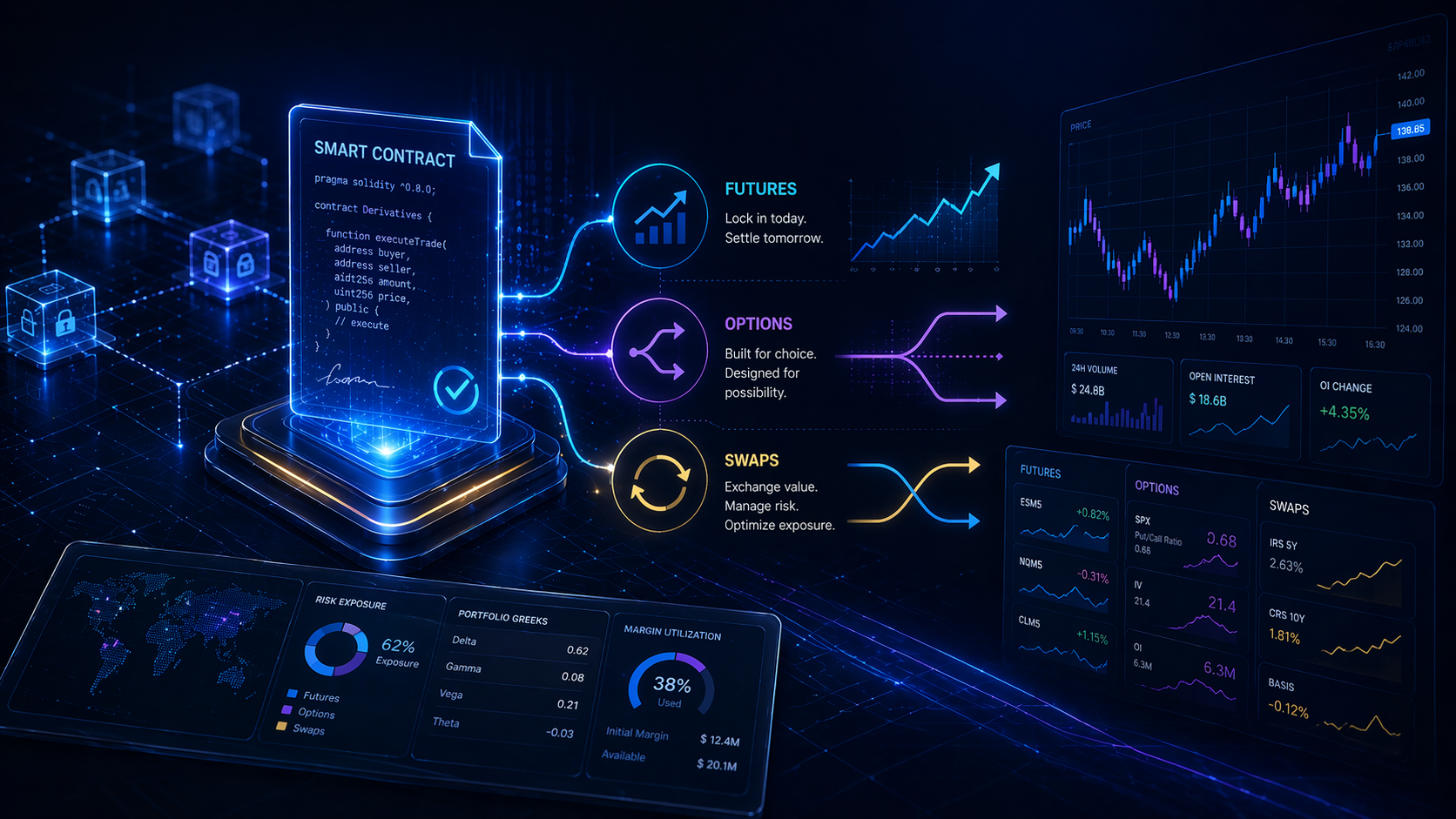
Futures allow you to lock in a sale price for your asset today at a specified future date. If you hold a tokenized commodity position and anticipate market volatility, a futures contract lets you guarantee your exit price before the volatility arrives. Certainty replaces exposure.
Options give you the right — without the obligation — to buy or sell your asset at a pre-agreed price within a defined window. For a real estate token holder, this means setting a price floor on your asset's value, or giving institutional investors a structured entry point without committing to a full sale. Options are the most flexible risk management instrument available — and on smart contract rails, they are accessible to any asset owner.
Swaps allow you to exchange one income stream for another without selling the underlying asset. If your tokenized IP generates royalty income tied to a variable rate structure, a swap enables you to exchange that uncertainty for a fixed, predictable cash flow — protecting your planning and budget without liquidating your position.
Together, these instruments give tokenized asset holders access to the same risk management toolkit that has been available exclusively to institutions for decades. The difference is that on Spydraa, they execute transparently, automatically, and without gatekeeping.
Spydraa is not a cryptocurrency exchange. It is not a speculative token platform. It is not another yield farm looking for liquidity to extract.
Spydraa is the trading layer for the tokenized real economy.
That distinction matters. Spydraa is built specifically for real-world asset holders — people who own things of genuine value and need a marketplace where that value can be actively traded, hedged, and managed through live derivatives markets.
Three capabilities define the platform:
Real liquidity. Spydraa connects tokenized assets to an active derivatives market with live price discovery. Your asset is not just minted on a blockchain and left to sit — it enters a market with real buyers, real sellers, and real bid-ask dynamics. Liquidity is the product.
Real speed. Every trade on Spydraa settles through audited smart contracts. There are no manual clearing windows, no T+2 delays, no counterparty back-office processes. Trades execute and settle in real time, giving you immediate clarity on your position.
Real security. Spydraa's contract infrastructure is built on audited, independently verified code. Every futures contract, every options position, every swap is enforced by the protocol — not by the counterparty's good faith or the reliability of a third-party intermediary.
For asset owners who have spent years navigating a system designed for institutions, Spydraa is the first platform built around the assets you actually hold.
The tokenization window is not permanent. Early movers in any financial infrastructure shift capture structural advantages — lower cost of capital, broader investor access, and market positioning that compounds over time.
Consider what is already happening:
The asset owners entering these markets now are not doing so speculatively. They are solving a real problem — illiquidity — with a structural solution that is finally available outside the institutional tier.
You do not need to tokenize your entire portfolio on day one. You need to understand the opportunity clearly enough to make a deliberate decision — and then take one concrete step.
Here is a straightforward starting framework:
Identify your most illiquid valuable asset. What do you own that has real value but is difficult to trade, hard to attract investors to, or expensive to sell? That is your tokenization candidate.
Understand the legal and technical structure. Tokenization involves compliance steps that vary by jurisdiction and asset class. Spydraa's team is built to walk asset owners through this — not as a blockchain engineering exercise, but as a business decision with clear inputs and outputs.
Start with Spydraa. Visit the platform, explore the active derivative markets, and open a conversation with the team. The infrastructure is live. The market is active. The only variable is whether you are in it.
The financial system that ignored your asset class for decades is not going to redesign itself. But the infrastructure that replaces it is being built right now — by asset owners who decided that illiquidity was a problem worth solving.
Your asset is real. The liquidity it deserves is finally real too.
→ Visit Spydraa.app and unlock the market your asset was always worth.