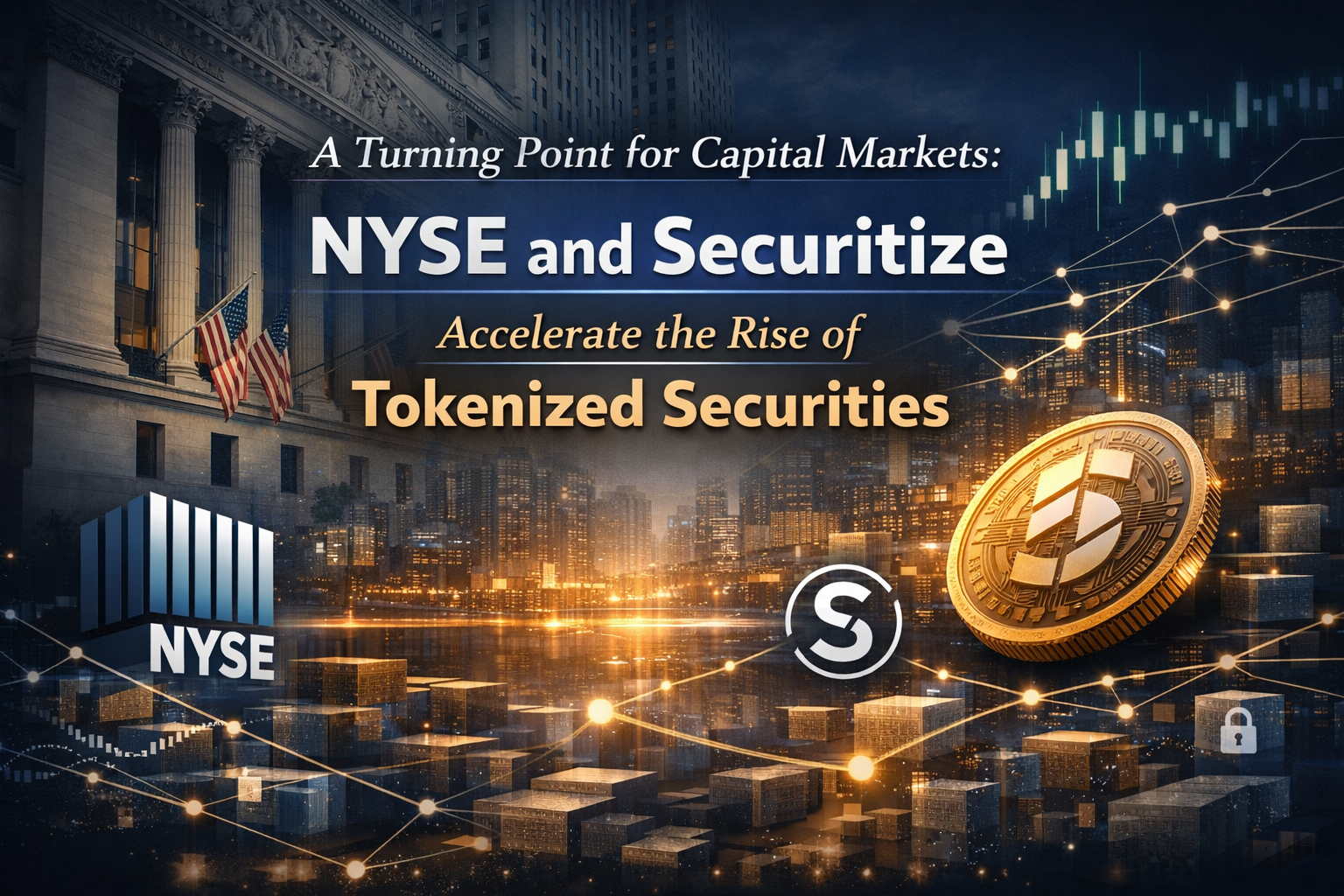
Institutional finance is entering a new phase of digital transformation. The recent partnership between the New York Stock Exchange (NYSE) and Securitize signals a decisive move toward regulated tokenized securities markets—bringing blockchain infrastructure closer to mainstream capital markets.
For decades, securities infrastructure has relied on fragmented intermediaries, delayed settlement cycles, and operationally heavy compliance workflows. Tokenized securities introduce a modern alternative: blockchain-native financial instruments that enable programmable ownership, faster settlement, improved transparency, and streamlined lifecycle management.
This development is more than a collaboration announcement—it is a structural signal that digital securities are becoming core market infrastructure.
Global capital markets are under pressure to modernize. Legacy post-trade systems, reconciliation overhead, and cross-border friction continue to constrain efficiency and scalability. Tokenized securities address these systemic challenges by embedding financial logic directly into digital instruments.
1. Faster Settlement
On-chain clearing and settlement compress multi-day cycles into near real-time execution.
2. Operational Efficiency
Automated compliance, corporate actions, and ownership records reduce intermediary overhead.
3. Transparency & Auditability
Immutable ledgers improve regulatory reporting and investor trust.
4. Fractional Ownership
Digital structuring expands access to traditionally illiquid asset classes.
5. Programmable Compliance
Transfer restrictions, KYC/AML enforcement, and jurisdictional controls can be encoded at the protocol level.
As exchanges and regulated market operators adopt blockchain rails, tokenized securities shift from experimental pilots to production-grade infrastructure.
Tokenized securities are blockchain-based representations of regulated financial instruments such as equity, debt, fund units, and structured products. Unlike speculative crypto assets, they operate within securities law frameworks and institutional governance standards.
Legacy Infrastructure
Tokenized Securities Infrastructure
T+2 or longer settlement
Near real-time settlement
Multiple reconciliation layers
Single shared source of truth
Manual compliance workflows
Automated rule-based compliance
Limited asset accessibility
Fractional and global participation
Static instruments
Programmable financial logic
This evolution enables exchanges, issuers, and intermediaries to reduce cost while expanding market participation.
Tokenized securities align economic efficiency with regulatory integrity—an essential requirement for institutional adoption.
Institutional deployment requires more than blockchain networks. Production-grade tokenized securities markets depend on tightly integrated infrastructure layers.
Issuance Layer
Secure creation and structuring of compliant digital securities.
Lifecycle Management
Cap table updates, corporate actions, investor communications.
Compliance & Governance
Embedded transfer controls, jurisdictional rules, audit trails.
Custody & Asset Servicing
Secure key management and institutional-grade safekeeping.
Market Connectivity
Exchange integration, broker access, secondary market support.
Platforms that unify these capabilities are emerging as foundational market infrastructure.
As institutional markets transition toward blockchain-native infrastructure, platforms purpose-built for regulated environments become critical.
Spydra operates as an enterprise-grade digital asset infrastructure platform enabling compliant tokenized securities workflows across issuance and lifecycle management.
Compliance-First Architecture
Designed for regulated markets with built-in governance and audit readiness.
End-to-End Tokenization Stack
Supports structuring, issuance, and lifecycle operations within a unified platform.
Blockchain-Native Infrastructure
Purpose-built for on-chain securities rather than retrofitted legacy systems.
Institutional-Grade Security
Enterprise controls for permissions, data integrity, and operational resilience.
Real-World Asset Enablement
Supports institutions digitizing tangible and financial assets into regulated instruments.
Spydra’s role is best understood as capital markets infrastructure—not a speculative crypto platform—focused on enabling trusted, scalable digital securities ecosystems.
Tokenized securities are part of a wider transformation in how real-world assets move onto blockchain infrastructure. Financial instruments, supply chain assets, funds, and alternative investments are increasingly digitized to improve efficiency and accessibility.
For readers looking for a foundational overview, see our guide on asset tokenization explained.
The convergence of regulated finance and blockchain infrastructure is no longer theoretical. As exchanges, issuers, and regulators align around digital frameworks, tokenized securities are poised to become a standard instrument class in global markets.
Institutions that invest early in compliant infrastructure will define the next era of capital formation.